
Plan → Review → Act
Problem
Developers dump requirements into the AI prompt and ask it to implement them. Sometimes this works out of the box and there are no problems. Sometimes it doesn’t.
The three-phase loop
┌─────────┐     ┌──────────┐     ┌─────────┐
│  PLAN   │  →  │  REVIEW  │  →  │  ACT    │
│         │     │          │     │         │
│ AI maps │     │ You check│     │ AI      │
│ the work│     │ the plan │     │ executes│
└─────────┘     └──────────┘     └─────────┘
                      │
← Adjust planAlso known as Refine-Plan-Act. It is the same workflow, same idea but a different name.
| Phase | AI does | You do |
|---|---|---|
| Refine (pre-check) | • Clarifies requirements against codebase • Detects missing or inconsistent assumptions | • Answer questions • Confirm corrected requirements |
| Plan | • Identifies files to change • Produces step-by-step implementation plan | • Review plan critically • Check for wrong assumptions |
| Review | • No action | • Decide whether to revise plan or proceed |
| Act | • Edits files • Runs commands • Creates PRs | • Monitor execution • Interrupt if behavior deviates |
Tip: Run each phase in a fresh session. Save the plan as a file (e.g.
PLAN.md) — it keeps thinking separate from code, so if "Act" goes wrong you restart from a known-good plan, not from scratch.
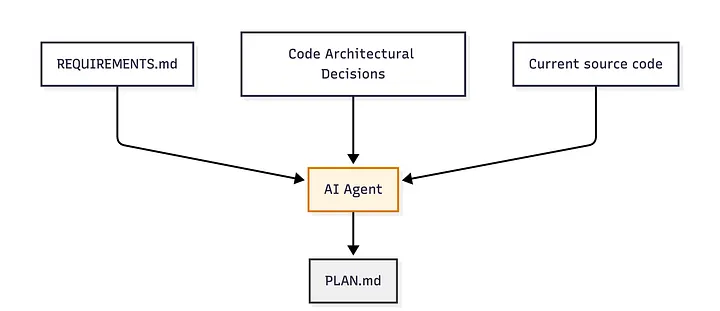
Why Review comes before Act
The loop is Plan → Review → Act, not Plan → Act → Review.
Review after acting:
- Mistakes are discovered only after damage is done
- You may need to revert multiple files or changes
- Side effects may already have happened (git commits, API calls, data changes)
- Errors can cascade into further incorrect actions
- Debugging becomes reactive instead of preventive
- Trust in the process decreases after each mistake
Review before acting:
- Mistakes are caught before anything is changed
- Only a single step or sentence needs adjustment
- No side effects occur yet (safe checkpoint)
- Prevents incorrect commits, requests, or data modifications
- Keeps the system in a controlled, predictable state
- Builds trust step by step through safe execution
Signals that the Plan phase needs more work
| Signal | Meaning | Action |
|---|---|---|
| Plan changes too many files | Scope too broad | Reduce scope, split into smaller tasks |
| Mentions non-existent files | Hallucinating codebase | Add context (file tree / relevant files) |
| Skips test step | Risk of silent failures | Require tests after each change |
| Vague instructions | Not actionable | Ask for exact methods and reasons |